In the three months ending April 2026, the median sale price of a home in Soulard dropped 17.1 percent year over year, settling at $377,000. In that same window, the median sale price per square foot climbed 8.8 percent, to $160. Same neighborhood. Same three months. Two numbers pointing in opposite directions.
If you're comparing Soulard to Lafayette Square, Tower Grove South, or a suburb further out, this matters more than it might seem. Median price is the number most people reach for first when sizing up a market. In a neighborhood this small, that number can lie to you without anyone doing anything wrong.
Why 18 Sales Can Break a Median
Soulard recorded 18 home sales in April 2026, up slightly from 16 the year before. That's the entire sample the median-price calculation is built on. With a pool that small, one high-end rehab closing alongside a run of studio conversions can shift the midpoint by tens of thousands of dollars without any real change in what buyers are actually paying per square foot.
That's exactly what appears to be happening here. Look at a longer window instead of the three-month snapshot and the story flips: the trailing 12-month median sale price in Soulard sits at $381,000, up 9 percent over the prior year, according to Homes.com's neighborhood data. Redfin's three-month read says down 17 percent. Both figures are accurate. They're measuring different slices of a market too thin to hold still.
The days-on-market number backs this up. Homes in Soulard are now taking 43 days to sell on average, compared with 19 days a year earlier. Demand didn't disappear. It slowed down and got more selective about which homes it moves fast on.
The Real Divide Isn't Address. It's Condition.
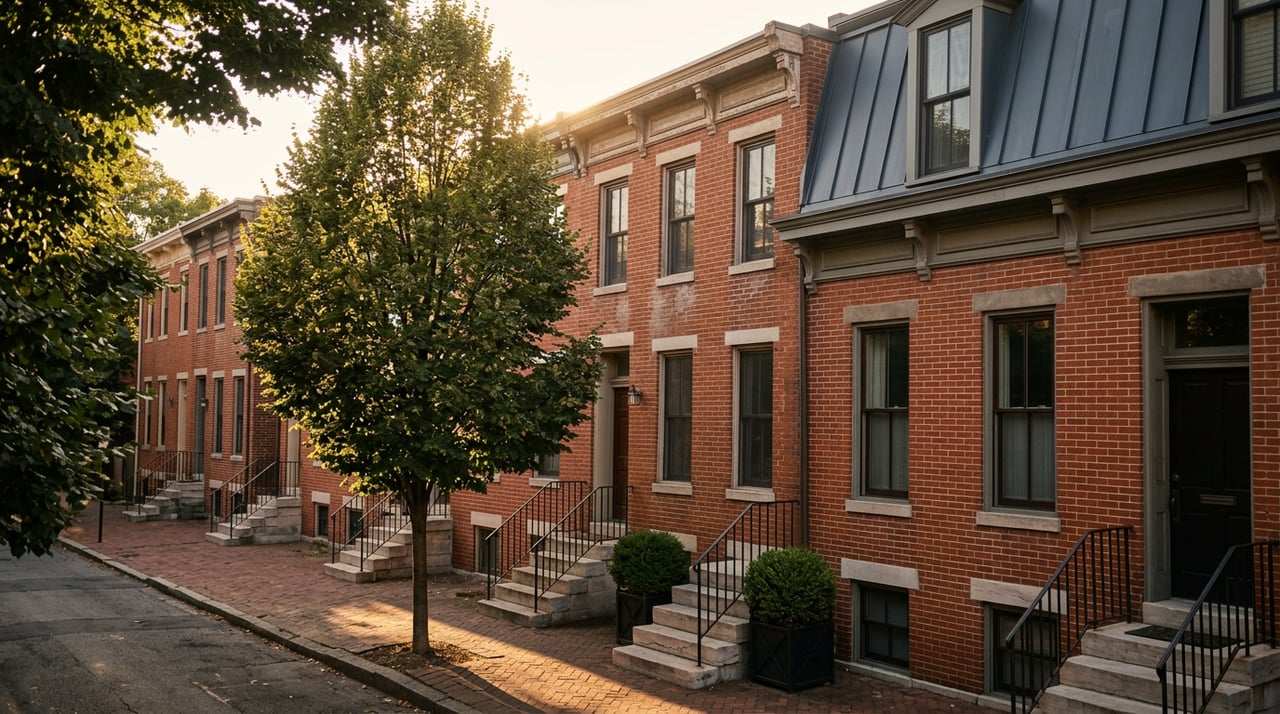
More than 70 percent of Soulard's residential buildings went up before 1939, many of them brick Colonial, Federal-style, and Victorian rowhouses dating to the 1870s through the early 1900s. Some of those buildings have been fully rehabbed into single-family showpieces or turnkey condo conversions. Others are still running on original systems, split awkwardly across floors that haven't been touched since a previous owner carved them into apartments decades ago.
That gap shows up every time a comp gets pulled. Here's what four recent Soulard sales looked like, condition and all:
| Address | Built | Size | Sold | Price/SF | Days on Market |
|---|---|---|---|---|---|
| 1228 Russell Blvd | 1907 | 1,175 sq ft | Nov 2025 | $200 | 5 |
| 1840 S 10th St | 1885 | 1,344 sq ft | Apr 2026 | $145 | 12 |
| 2222 S 12th St | 1872 | 4,023 sq ft | Feb 2026 | $123 | 187 |
| 2353 S 11th St | 1890 | 2,289 sq ft | Dec 2025 | $85 | not listed |
The spread between the top and bottom of that table is more than double, per square foot, in a neighborhood that spans roughly eight blocks. The home at 1228 Russell sold in five days. The home at 2222 S 12th sat for 187 days. Age isn't the differentiator. Both were built in the 1800s. Condition is.
Part of why Soulard's untouched inventory stays untouched longer than it might in a newer neighborhood comes down to what it takes to fix it. Soulard is a locally designated historic district, which means exterior work on these buildings goes through the city's Cultural Resources Office before a permit gets pulled. That review step adds cost and time to a full rehab, which is part of why a decade of visible gentrification hasn't erased the split between move-in-ready and original-condition stock. The buildings that get fully renovated tend to get renovated by owners or investors with the budget and patience for it. The rest wait for a buyer with the same appetite.
New Inventory Is Entering at the Top of the Range
Two current projects give a sense of where the renovated end of the market is headed. Renovations Unlimited LLC, led by Ronald Seabaugh, is putting $1.4 million into converting the buildings at 2330-32 S. 12th St into seven condos. Separately, 1001 Russell LLC purchased the property at 1001-03 Russell Blvd for $410,000 and plans to spend roughly $4.1 million building a new mixed-use structure with 21 residential units and two commercial spaces, according to reporting from the St. Louis Business Journal.
Both projects are adding inventory priced at the renovated, higher-per-square-foot end of the spectrum. That's likely to keep nudging the price-per-square-foot figure upward even during a stretch where the three-month median looks soft. It's also inventory that won't read like the neighborhood's historic single-family stock. A new condo unit inside a converted building is a different product than a fully rehabbed two-story Victorian a block away, even if both show up under the same neighborhood filter on a listing site.
What This Means If You're Comparing Soulard to Somewhere Else
If you're using median price to rank Soulard against another St. Louis neighborhood, the first question worth asking is which window you're looking at. A three-month median and a twelve-month median can point in opposite directions in a market this thin, and neither one is wrong. Price per square foot is a steadier anchor, but it still assumes you're comparing homes in similar condition. A renovated comp pulled against an original-condition listing will misprice a home by tens of dollars per square foot in either direction.
For sellers, this means comp selection matters more than proximity. The house two doors down might be the wrong comp if it was gutted three years ago and yours hasn't been touched since the 1990s.
For buyers, a long stay on market, like the 187 days at 2222 S 12th St, isn't automatically a red flag. In a neighborhood where original wiring and layout can scare off buyers without a rehab budget in mind, extra time on market often reflects the pool of interested buyers narrowing, not the home losing value. That can be a real opening at the negotiating table for someone who's ready to do the work.
A Couple of Questions Worth Asking Directly
Does a falling median price mean Soulard homes are getting cheaper? Not necessarily. With only 16 to 18 sales a month, the median can swing on which few homes happen to close in a given window rather than on any broad shift in value. Price per square foot and days on market tell you more about underlying demand than the median alone.
Why do similarly sized homes sell for such different prices per square foot here? Condition and renovation history explain most of the gap. Soulard's historic district status also adds a review step to exterior rehab work, which raises the cost and timeline of a full renovation and helps explain why fully updated and original-condition homes keep trading at very different price points within the same few blocks.
Soulard rewards buyers and sellers who look past the headline number. If you're weighing this neighborhood against another part of the city or trying to figure out what a specific block is actually worth right now, The Drew Group can walk through the comps with you block by block. Let's Connect.